
| What it is | Maitake (Grifola frondosa) is a large, frilly “hen of the woods” mushroom, traditionally used to support everyday immune balance and metabolic wellness. |
| How it works | It is rich in beta-glucans, and carries a well-studied purified fraction known as the D-fraction (a related refined version is the MD-fraction). |
| Sensible dose | Extract-based products commonly supply roughly 500–3,000 mg per day; consistency over several weeks matters more than a single large dose. |
| On the label | Look for a named species, a fruiting-body extract and, ideally, a stated beta-glucan percentage rather than raw ‘mushroom powder’. |
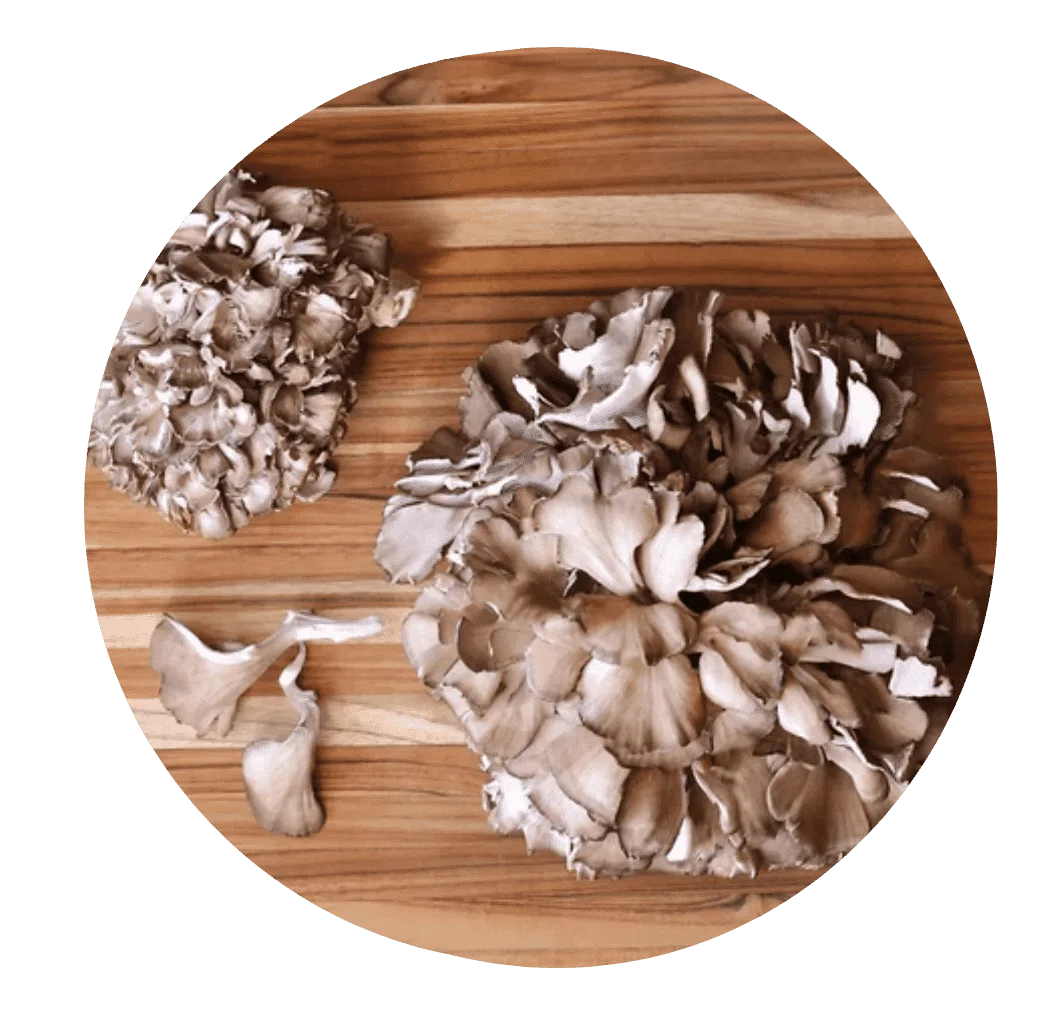
If you have browsed a specialist grocer or a farmers’ market, you may have spotted a mushroom that looks less like a single cap and more like a ruffled bouquet of overlapping grey-brown fronds. That is maitake — and in Japanese its name translates as “dancing mushroom.” This guide explains, in plain English, what the maitake mushroom benefits actually are, what the famous D-fraction is and how it is thought to work, how much people take, and how to tell a serious product from a marketing gimmick on the shelf.
Maitake (Grifola frondosa) is a large edible mushroom that grows in clustered, overlapping fronds at the base of oaks and other hardwoods. In English it is often called hen of the woods, because a mature cluster can resemble the ruffled feathers of a sitting hen. Unlike the leathery turkey tail, maitake is genuinely delicious as food, with a rich, savoury flavour that makes it a prize for foragers and chefs alike.
It has a long history in traditional East Asian food and wellness practice. In the modern supplement world, maitake is valued as an immune-and-metabolic wellness mushroom, and it is one of the six functional mushrooms in the Mindoxa blend, where it complements the more cognition-focused species to build a rounded, whole-body formula.
This is where maitake gets genuinely interesting, and where a little mechanism knowledge helps you shop smarter. Like every functional mushroom, maitake is rich in beta-glucans — the fibre-like polysaccharides that sit at the heart of the whole category and drive much of its traditional wellness reputation. If you want the deeper story on those, we wrote a whole explainer on what beta-glucans in functional mushrooms actually are.
What sets maitake apart is that researchers were able to isolate a specific, well-characterised beta-glucan from it:
Because these fractions are defined and purified, maitake has been studied more precisely than many mushrooms whose “active” is left vague on the label. It is important, though, to be honest about the state of the evidence: much of the most rigorous work involves the isolated, standardised D-fraction or MD-fraction rather than an off-the-shelf capsule, and a good deal of it has been done in laboratory and clinical settings that do not translate directly into everyday consumer claims. That is exactly why responsible writing about maitake sticks to the language of traditional and general use and avoids promising specific outcomes. Maitake is a dietary supplement, not a medicine.
So what do people actually reach for maitake hoping to support? In traditional and everyday use, the mushroom is associated with:
Notice what is not on that list: maitake is not a cure for any medical condition, and it is not a substitute for the metabolic fundamentals of diet, movement and sleep. It is also not a focus supplement in the way lion’s mane is used for memory and focus — the two mushrooms play very different roles, which is exactly why a blend uses both.
There is no single official dose, because it depends heavily on the form of the product. A concentrated extract is not the same as raw powder, so comparing milligram numbers between products only works if you also know how concentrated each one is. As a general orientation:
The single most useful habit is to follow the directions on your specific product label and to start at the lower end if you are new to functional mushrooms. If you are pregnant, nursing, under 18 or taking medication — particularly medication for blood sugar — talk to your physician before starting any new supplement.
Mindoxa combines maitake with lion’s mane, cordyceps, reishi and two more functional mushrooms in a once-daily capsule — no chopping, no cooking, backed by a 60-day guarantee.
See Mindoxa Packages
This is where mechanism knowledge pays off at the checkout. Because the D-fraction is concentrated in the mushroom’s fruiting body, the part of the mushroom used and the way it was extracted are not trivial details — they change what you are actually buying. When you read a label, look for:
“D-fraction” is not a marketing invention; it is the name given to a specific protein-bound beta-glucan fraction isolated from Grifola frondosa. A 2021 review in Foods on the bioactive ingredients and medicinal values of Grifola frondosa sets out the chemistry and the range of preparations sold under the name, which vary far more than the shared label suggests.
The research itself is preclinical. A 2002 study in the Biological and Pharmaceutical Bulletin examined the fraction’s effect on T-lymphocyte populations, and a 2015 paper in the Journal of Leukocyte Biology reported that a soluble beta-glucan from Grifola frondosa acted in synergy with a TLR9 agonist in a mouse model. Both are animal and laboratory studies, and neither supports a claim about what a capsule will do for a healthy person.
The general context is better established than the specific claim: a 2021 review in Nutrients on edible mushrooms and beta-glucans in human health treats them as fermentable fibres with plausible immune interactions rather than as active drugs. And because “D-fraction” on a label is unregulated, the same label-reading discipline applies here as it does to chaga and its antioxidant compounds — look for the species, the part used and a stated beta-glucan percentage.
Maitake earns its place as a whole-body wellness mushroom for a reason: it pairs a long history of traditional use with an unusually well-defined active compound in the D-fraction, all built on the same beta-glucan foundation shared across the category. The honest framing is that it is gentle daily support for everyday immune balance and metabolic wellness — most effective when it sits on top of good sleep, movement and nutrition, and when you choose a well-labelled fruiting-body extract with a stated beta-glucan percentage. If you would rather not manage a cupboard of single-mushroom jars, a thoughtfully combined blend like Mindoxa puts maitake alongside five complementary mushrooms in a single daily capsule. Curious how the immune-focused end of the blend works? Read our companion guide on turkey tail mushroom benefits.
Maitake is traditionally used to support everyday immune balance and general metabolic wellness. Its reputation rests on a rich supply of beta-glucans, and in particular a well-studied fraction known as the maitake D-fraction. It is best thought of as gentle daily support taken consistently over time.
The D-fraction is a purified beta-glucan extracted from the maitake mushroom (Grifola frondosa). It is a protein-bound polysaccharide and is the compound most closely associated with maitake in the research literature. A related, more refined version is sometimes called the MD-fraction.
There is no single official dose. Extract-based products commonly supply somewhere in the region of 500 to 3,000 mg per day, though the right amount depends on the concentration of the specific extract. Always follow the directions on your product label and start at the lower end if you are new to functional mushrooms.
Maitake is not primarily a cognitive mushroom the way lion’s mane is. It is best known as an immune-and-metabolic wellness mushroom. In a blend it plays a supporting role, contributing beta-glucans and its signature D-fraction alongside the more focus-oriented mushrooms.
Look for the Latin name Grifola frondosa, a fruiting-body extract rather than raw mycelium-on-grain powder, and ideally a stated beta-glucan percentage. Vague terms like ‘mushroom complex’ with no species or extraction detail are a red flag.
The Mindoxa Research Team is a small group of nutrition writers, label analysts and wellness researchers who read the primary literature on functional mushrooms so you don't have to. We translate dense mycology and supplement-science papers into plain-English guides, and we update our articles as the evidence and the labels on the shelf change.
Everything we publish is independently written and fact-checked. We describe traditional and general use only — we do not give medical advice, and we always point you back to your own physician for anything specific to your health. Have a correction or a source we missed? Get in touch.
† These statements have not been evaluated by the FDA. This product is not intended to diagnose, treat, cure or prevent any disease. This article is for general information only and is not medical advice.