
| What it is | Turkey tail (Trametes versicolor) is a common shelf mushroom with banded, fan-shaped caps, traditionally used to support everyday immune balance and general wellness. |
| How it works | It is unusually rich in beta-glucans and carries two heavily studied protein-bound polysaccharides, PSK and PSP. |
| Sensible dose | Extract-based products commonly supply roughly 500–2,000 mg per day; consistency over several weeks matters more than a single large dose. |
| On the label | Look for a named species, a fruiting-body extract and, ideally, a stated beta-glucan percentage rather than raw ‘mushroom powder’. |
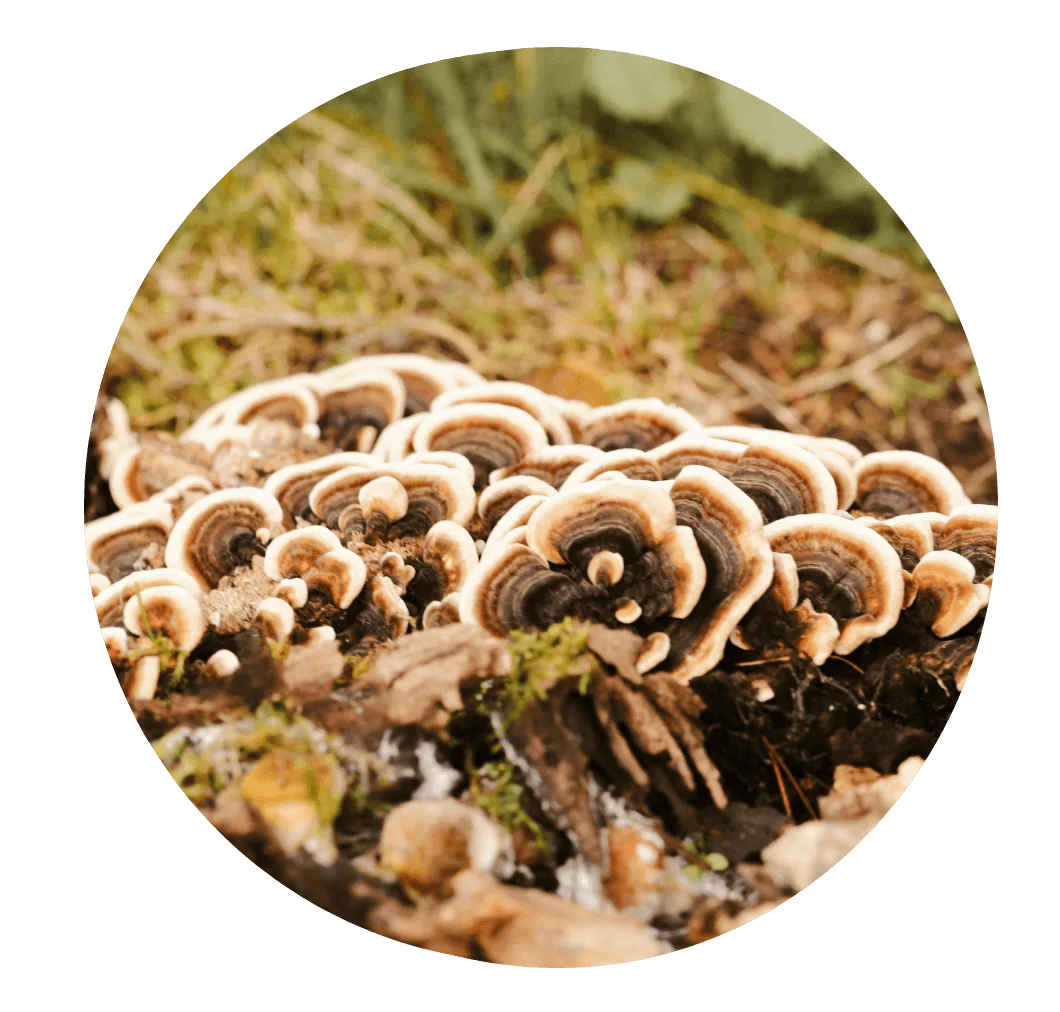
If you have ever walked through a forest and noticed rows of small, fan-shaped mushrooms with concentric bands of colour fanning out along a fallen log, you have almost certainly met the turkey tail mushroom. It is one of the most common mushrooms in the world, and it is also one of the most thoroughly researched in the entire functional-mushroom category. This guide explains, in plain English, what the turkey tail mushroom benefits actually are, how the mushroom is thought to work through its PSK and PSP compounds, how much people take, and how to tell a serious product from a marketing gimmick on the shelf.
Turkey tail (Trametes versicolor, and on older labels Coriolus versicolor) is a bracket or “shelf” mushroom that grows in overlapping tiers on dead and dying hardwood. Its Latin name is a good description: versicolor means “of many colours,” and the caps really do fan out in rings of brown, tan, grey, rust and cream that resemble the tail of a wild turkey. Unlike the fleshy mushrooms you would sauté, turkey tail is thin, tough and leathery, which is why it is taken as a tea or an extract rather than eaten as food.
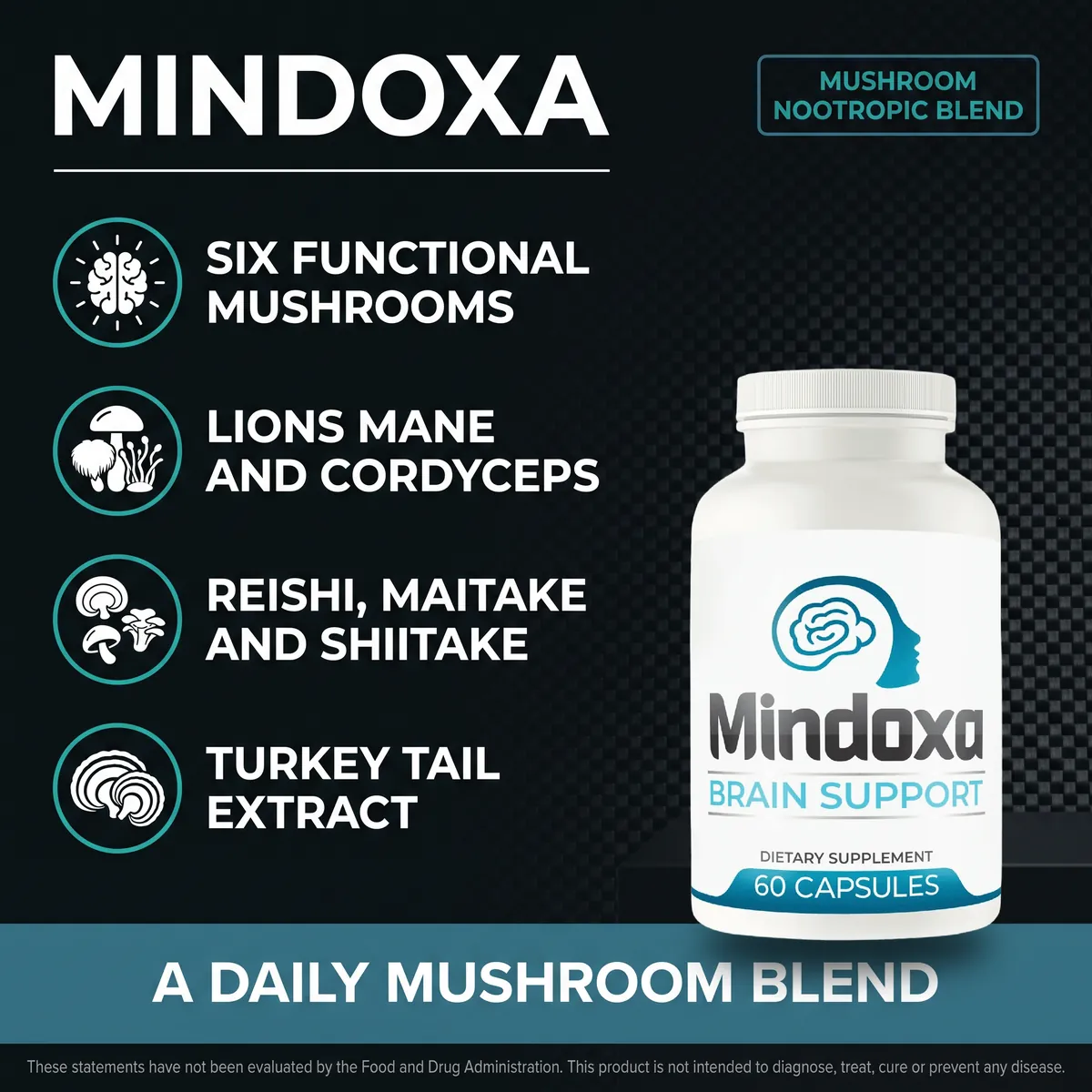
It has a long history in traditional East Asian practice, where it has been brewed and used for general wellness for centuries. In the modern supplement world it is the classic immune-support mushroom, and it is one of the six functional mushrooms in the Mindoxa blend, where it sits alongside the more cognition-focused species to round out the formula.
This is where turkey tail earns its reputation, and where a little mechanism knowledge helps you shop smarter. The mushroom is unusually rich in two families of active compounds:
Both PSK and PSP are, at their core, beta-glucans bound to protein. Beta-glucans are the fibre-like polysaccharides that sit at the heart of nearly every functional mushroom, and they are the compounds most closely associated with the category’s traditional wellness reputation. If you want the deeper story on those, we wrote a whole explainer on what beta-glucans in functional mushrooms actually are, and it pairs naturally with this article.
It is important to be honest about the state of the evidence. Turkey tail and its isolated fractions have been the subject of a genuinely large body of research, but much of the most rigorous work involves standardised, isolated PSK or PSP rather than an off-the-shelf capsule, and a great deal of it has been done in laboratory and clinical settings that do not translate directly into everyday consumer claims. That is exactly why responsible writing about turkey tail sticks to the language of traditional and general use and avoids promising specific outcomes. Turkey tail is a dietary supplement, not a medicine.
So what do people actually reach for turkey tail hoping to support? In traditional and everyday use, the mushroom is associated with:
Notice what is not on that list: turkey tail is not a cure for any medical condition, and it is not a nootropic in the way lion’s mane is used for memory and focus. It is best framed as steady, daily wellness support that works with the fundamentals of sleep, movement and nutrition rather than instead of them.
There is no single official dose, because it depends heavily on the form of the product. A concentrated extract is not the same as raw powder, so comparing milligram numbers between products only works if you also know how concentrated each one is. As a general orientation:
The single most useful habit is to follow the directions on your specific product label and to start at the lower end if you are new to functional mushrooms. If you are pregnant, nursing, under 18 or taking medication, talk to your physician before starting any new supplement.
Mindoxa combines turkey tail with lion’s mane, cordyceps, reishi and two more functional mushrooms in a once-daily capsule — no bitter mushroom tea, backed by a 60-day guarantee.
See Mindoxa Packages
This is where mechanism knowledge pays off at the checkout. Because the PSK and PSP fractions are concentrated in the mushroom itself, the part of the mushroom used and the way it was extracted are not trivial details — they change what you are actually buying. When you read a label, look for:
Turkey tail has more published research behind it than any other mushroom in a typical blend, and almost all of it concerns two protein-bound polysaccharides: PSK (polysaccharide-K, marketed in Japan as krestin) and PSP. Laboratory work has focused on how they are recognised by the innate immune system — a 2010 paper in Fitoterapia implicated toll-like receptor 4 in the macrophage response to PSK, and a 2014 study in Innate Immunity described activation through TLR2 and the NLRP3 inflammasome.
The clinical literature is where care is needed. PSK has been used as an adjuvant alongside conventional cancer treatment in Japan, and a 2022 Cochrane systematic review assessed Coriolus preparations for reducing treatment side effects in colorectal cancer, concluding that the evidence was too limited and too uncertain to support firm conclusions. None of that transfers to a dietary supplement taken by a healthy adult, and nothing here should be read as a treatment claim.
For everyday use, the sensible framing is the one taken by a 2021 review in Molecules on mushroom-derived bioactive molecules as immunotherapeutic agents: these are interesting, well-studied fungal polysaccharides whose oral effects in healthy people remain modestly evidenced. The same is true of the antioxidant claims made for chaga, and the same caution about dose and quality applies — see our guide to functional mushroom side effects and safety before you start.
Turkey tail earns its place as the classic wellness mushroom for a reason: it pairs a long history of traditional use with one of the largest research files in the whole category, built around its beta-glucans and the PSK and PSP polysaccharides. The honest framing is that it is gentle daily support for everyday immune balance and general wellness — most effective when it sits on top of good sleep, movement and nutrition, and when you choose a well-labelled fruiting-body extract with a stated beta-glucan percentage. If you would rather not manage a cupboard of single-mushroom jars, a thoughtfully combined blend like Mindoxa puts turkey tail alongside five complementary mushrooms in a single daily capsule.
Turkey tail is traditionally used to support everyday immune balance and general wellness. Its reputation rests on a rich supply of beta-glucans and two well-studied polysaccharide fractions, PSK and PSP. It is best thought of as gentle daily support taken consistently over time, not a fast-acting remedy.
PSK (polysaccharide-K, sometimes called krestin) and PSP (polysaccharopeptide) are protein-bound polysaccharides isolated from Trametes versicolor, the turkey tail mushroom. They are among the most researched compounds in the whole functional-mushroom category and are the main reason turkey tail is prized as an immune-supporting mushroom.
There is no single official dose. Extract-based products commonly supply somewhere in the region of 500 to 2,000 mg per day, though the right amount depends on the concentration of the specific extract. Always follow the directions on your product label and start at the lower end if you are new to functional mushrooms.
Turkey tail is not usually taken for focus or memory the way lion’s mane is. It is best known as an immune-and-wellness mushroom. In a blend it plays a supporting role, contributing beta-glucans and its signature PSK and PSP fractions alongside the more cognition-focused mushrooms.
Look for the Latin name Trametes versicolor (older labels may say Coriolus versicolor), a fruiting-body extract rather than raw mycelium-on-grain powder, and ideally a stated beta-glucan percentage. Vague terms like ‘mushroom blend’ with no species or extraction detail are a red flag.
The Mindoxa Research Team is a small group of nutrition writers, label analysts and wellness researchers who read the primary literature on functional mushrooms so you don't have to. We translate dense mycology and supplement-science papers into plain-English guides, and we update our articles as the evidence and the labels on the shelf change.
Everything we publish is independently written and fact-checked. We describe traditional and general use only — we do not give medical advice, and we always point you back to your own physician for anything specific to your health. Have a correction or a source we missed? Get in touch.
† These statements have not been evaluated by the FDA. This product is not intended to diagnose, treat, cure or prevent any disease. This article is for general information only and is not medical advice.